disp_surface_t
![[Previous]](prev.gif) |
![[Contents]](contents.gif) |
![[Index]](keyword_index.gif) |
![[Next]](next.gif) |
disp_surface_t
Description of a two-dimensional surface
Synopsis:
#include <display.h>

typedef struct disp_surface {
    int             size;
    unsigned        pixel_format;
    unsigned        offset;
    unsigned char   *vidptr;
    uintptr_t       paddr;
    unsigned        stride;
    unsigned        flags;
    int             width;
    int             height;
    disp_color_t    *palette;
    int             palette_valid_entries;
    disp_adapter_t  *adapter;
    unsigned        reserved;
} disp_surface_t;
Description:
The disp_surface_t structure describes a two-dimensional surface. It's used as an argument to several functions, and is also used within other structures, such as disp_draw_context_t.
The members include:
- size
- The size of this structure. Any time a driver creates a structure of this type, it should set this member to sizeof (disp_surface_t).
- pixel_format
- The pixel format. For more information, see "Pixel formats" in the Writing a Graphics Driver chapter.
- offset
- A device-dependent address that points to the start of the surface data.
- vidptr
- The virtual (CPU) address that points to the start of the surface data.
- paddr
- The physical (bus) address that points to the start of the surface data.
- stride
- The number of bytes from the beginning of one scanline to the beginning of the next (see diagram below).
- flags
- Surface flags, defined below.
- width
- The width of the surface, in pixels (see diagram below).
- height
- The height of the surface, in scan lines (see diagram below).
- pal_ptr
- A pointer to the palette for this surface. If not a palette type, this pointer is NULL.
- pal_valid_entries
- The number of entries that are valid in the pal_ptr palette. For palette-based surface data, pixel values in the data shouldn't exceed this value, otherwise they might reference past the end of the palette array.
- adapter
- A pointer to the disp_adapter_t structure for the device that created this surface (if any).
Relationship of stride, height, and width
The three members, stride, height, and width are used to define a surface as follows:
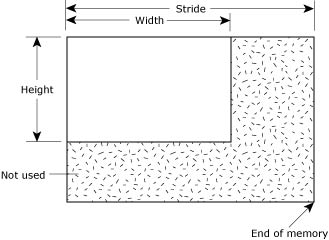
Memory layout.
The entire content of the box represents the total memory area available, and the unshaded portions represent the memory area that's actually used for the surface.
 |
Don't overwrite the "not used" areas; it might be used to store other surfaces. |
flags
The flags member is a bitmap of the following values:
- DISP_SURFACE_DISPLAYABLE
- The surface can be displayed via CRT controller.
- DISP_SURFACE_CPU_LINEAR_READABLE
- The CPU can read this surface directly.
- DISP_SURFACE_CPU_LINEAR_WRITEABLE
- The CPU can write to this surface directly.
- DISP_SURFACE_2D_TARGETABLE
- The 2D engine can render into this surface.
- DISP_SURFACE_2D_READABLE
- The surface is read-accessible by 2D engine.
- DISP_SURFACE_3D_TARGETABLE
- The 3D engine can render into surface.
- DISP_SURFACE_3D_READABLE
- The surface is read-accessible by 3D engine.
- DISP_SURFACE_SCALER_DISPLAYABLE
- The surface can be displayed via video overlay scaler.
- DISP_SURFACE_VMI_TARGETABLE
- Video capture hardware can write frames into this surface.
- DISP_SURFACE_DMA_SAFE
- The DMA engine can treat the surface memory as one contiguous block.
- DISP_SURFACE_PAGE_ALIGNED
- Surface memory starts on a page boundary.
- DISP_SURFACE_OTHER_ENDIAN
- Surface memory accesses by CPU are byte-swapped; the device on which the memory resides in the opposite "endian" from the CPU.
- DISP_SURFACE_NON_CACHEABLE
- The CPU shouldn't map the surface memory as cacheable.
- DISP_SURFACE_PHYS_CONTIG
- The surface memory is physically contiguous, from a bus master device's perspective.
Classification:
Photon
See also:
disp_adapter_t, disp_draw_context_t, disp_draw_contextfuncs_t, disp_draw_corefuncs_t, disp_draw_miscfuncs_t, disp_memfuncs_t, disp_modefuncs_t, disp_vidfuncs_t
|
|
|
|